Teaching Spanish Through Food in Film: Building Vocabulary That Lasts
Have you ever noticed how students remember vocabulary from a powerful food scene far longer than words from a textbook list?
They may forget the worksheet.
They may forget the quiz format.
They remember the grandmother’s hands folding masa.
Students recall the wedding cake that made everyone weep.
Many still talk about the street vendor who perfected one recipe for forty years.
That’s the power of food in film.
And when we harness it intentionally, it becomes one of the most effective tools for language acquisition.
Why Food Works So Well in Language Learning
Food is universal — but it is never neutral.
Food carries identity. In addition, it carries memory. It carries stories like:
- Family tradition
- Socioeconomic realities
- Celebration
- Loss
- Resistance
- Love
When students see food prepared, shared, or fought over on screen, they are not just watching a recipe unfold. They are watching culture in motion.
And when language is embedded inside emotion and story, it sticks.
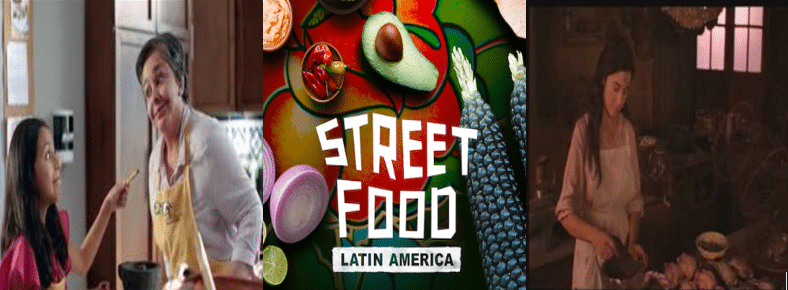
🍊 With Younger Students: Canela
With novice and younger students, films like Canela open the door to:
- ingredientes
- mezclar
- hornear
- dulce
- tradición
- familia
But more importantly, they open the door to feeling.
Students see recipes passed down through generations. They see the emotional weight of keeping a family tradition alive. They see that food is not just something you eat — it is something you inherit.
When we later review vocabulary, students don’t just recall the word hornear because they studied it. They remember it because they watched someone bake with purpose.
That emotional anchor strengthens retention in ways a textbook unit simply cannot replicate.
🌮 With Intermediate Students: Street Food – Latin America
When we move into intermediate levels, documentary storytelling becomes powerful.
In Street Food, students encounter:
- Authentic accents
- Regional dialects
- Real-life vendors
- Socioeconomic context
- Pride in craft
Now vocabulary expands into:
- sustento
- comunidad
- tradición culinaria
- negocio familiar
- esfuerzo
- perseverancia
We are no longer just teaching “foods.” We are teaching how food sustains families, defines neighborhoods, and reflects economic realities.
These conversations naturally connect to AP themes like:
- Contemporary Life
- Personal and Public Identities
- Global Challenges
Students begin to see that gastronomy is cultural expression.
And again — the vocabulary sticks because it is tied to human stories.
🌹 With Advanced Students: Como agua para chocolate
At the advanced level, food becomes metaphor.
In Como agua para chocolate, food carries:
- Desire
- Repression
- Passion
- Power
- Grief
Students explore magical realism through cooking. They analyze how emotion literally transfers into food. They discuss how gender roles and family expectations simmer beneath every recipe.
Now vocabulary becomes:
- anhelo
- opresión
- pasión desbordante
- destino
- tradición familiar
Students are not memorizing words. They are interpreting symbolism.
When we later assess them on interpretive writing or cultural comparison, their language is richer — because it was built inside narrative context.
The Science Behind Why This Works
As educators, we intuitively know that emotional engagement increases retention.
But research in cognitive science supports what we see every day:
- Emotion strengthens memory consolidation.
- Multisensory experiences build stronger neural pathways.
- Narrative context increases meaning-making and long-term recall.
When students watch steam rise from a pot while characters argue about destiny, they are engaging visually, emotionally, and linguistically at once.
A static vocabulary list simply cannot compete with that level of engagement.
Why Film + Food Is More Powerful Than a Textbook Unit
A textbook might give students:
una lista de vocabulario sobre la comida.
A film gives them:
- A grandmother who refuses to let a recipe die.
- A vendor who feeds an entire neighborhood.
- A young woman whose tears flavor a wedding cake.
When students watch hands knead dough that has been kneaded for fifty years, they are not memorizing vocabulary.
They are attaching language to identity.
And when language is attached to identity, memory deepens.
Bringing It Into Your Classroom
If you want to intentionally harness the power of food in film:
- Pre-teach essential vocabulary in context, not isolation.
- Pause and discuss cultural significance mid-scene.
- Ask students how food reflects identity or social class.
- Connect scenes to AP themes explicitly.
- Revisit vocabulary after the film — students will be amazed at how much they retained.
Final Thoughts
Food is one of the most accessible entry points into culture.
It is tangible.
It is emotional.
It is communal.
When we teach Spanish through film, and especially through gastronomy, we give students something far more powerful than vocabulary acquisition.
We give them connection.
And connection is what makes language last.